

Advocating for Policy That Enables Sustainable Woody Biomass Markets
For more than a decade, AWBA and its predecessor organization has worked within established renewable energy, sustainability, and trade frameworks in the United States, Europe and Asia.
Our members operate under real regulatory conditions and have firsthand experience implementing the policies now being reconsidered and expanded to address renewable carbon, fuels, and carbon management.
Our members operate under real regulatory conditions and have firsthand experience implementing the policies now being reconsidered and expanded to address renewable carbon, fuels, and carbon management.



Policy Navigation
Woody biomass operates within a policy landscape that is evolving quickly — shaped by climate goals, energy security priorities, and the need to deploy solutions at scale. AWBA engages in these conversations to help policymakers and regulators navigate that complexity with clear, evidence-based insight.

Advocacy Insights
AWBA’s role is to share what has been learned, including where policy design has worked well, where challenges have emerged, and how future frameworks can better align ambition with practical outcomes. We approach advocacy as a collaborative effort, serving as a technical resource to policymakers informed by real-world implementation and long-term operational experience.
Advocacy Priorities
AWBA’s advocacy is grounded in three core realities of the today's energy and carbon markets:
Industries Need Renewable Carbon Products
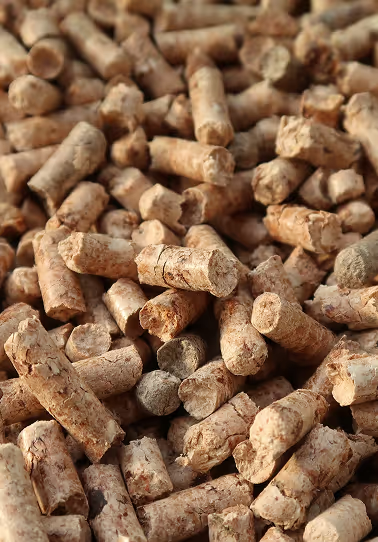
Numerous industries rely on renewable carbon for fuels, materials, chemicals, and manufacturing. Forest-derived carbon products deliver a scalable, sustainable supply to meet this essential demand across diverse markets seeking alternatives to fossil-based sources.

Working Forests Are Foundational
Well-managed working forests and the economic systems that sustain them are essential to maintaining a productive, domestic supply of renewable carbon products. Markets for low-value fiber support forest stewardship, forest health, and the long-term economic viability of forest-dependent communities.

Proven Supply Chains Must Be Fully Enabled
Woody biomass operates commercially with established infrastructure, management, certification systems, and market experience. Policy should build on this foundation to unlock the sector's full potential and guide deployment where it delivers maximum economic and environmental value.
Against that backdrop, AWBA’s advocacy priorities reflect the practical requirements of growing carbon product markets:

Ensuring renewable carbon is appropriately recognized as an essential solution, particularly for sectors that will continue to require carbon inputs.

Advancing science-based sustainability frameworks that build on established certification, traceability, and auditing systems and reinforce credible forest stewardship.

Supporting robust lifecycle assessment approaches grounded in forest growth, product use, and carbon flows over time, and aligned with real-world system performance.

Promoting policy certainty and continuity that enable long-term investment in infrastructure, markets, and skilled workforces.

Enabling emerging applications, including advanced fuels, industrial heat, and carbon removal pathways such as BECCS, where woody biomass can deliver meaningful climate and economic value.
Together, these priorities reflect a focus on policies that are ambitious, workable, and capable of supporting deployment at industrial scale while reinforcing sustainable forest management and credible climate outcomes.
U.S. Policy
In the United States, AWBA works to ensure that woody biomass is treated as a credible, scalable contributor to national goals for energy security, emissions reductions, and rural economic development. We engage across federal policy conversations where renewable carbon, low-carbon fuels, and carbon management incentives are being designed and refined.
U.S. policy is increasingly focused on accelerating new solutions, including sustainable aviation fuel and carbon capture, and biomass is positioned to serve as a practical feedstock and energy source for those priorities. Federal incentives such as the 45Z clean fuel production credit and the 45Q carbon capture credit are catalyzing investment and advancing pathways where forest-derived can play a meaningful role.
AWBA’s U.S. policy engagement supports frameworks that:

Recognize the role of working forests and sustainable sourcing.

Enable near-term emissions reductions using existing infrastructure.

Support market pathways that scale on strong standards over time.
International Policy

Internationally, woody biomass has been deployed at industrial scale for more than a decade, supporting renewable energy targets and the transition from coal . Core export markets include the United Kingdom, Japan, the Netherlands, and Denmark, underpinned by policy frameworks designed to decarbonize power systems while maintaining reliability.
As policies evolve, AWBA works to help ensure continuity, credibility, and forward momentum. In Europe, for example, historic renewable support schemes are changing, and in some cases concluding, creating a need for a smooth transition to next-generation frameworks, including pathways that may shift from power toward carbon removal through BECCS.
AWBA also monitors and engages on emerging international fuel policies, including sustainable aviation fuel mandates now taking shape across multiple jurisdictions. These frameworks will shape future demand for renewable carbon feedstocks and influence how new markets develop over time.
Be Part of the Platform Shaping the Future of Renewable Carbon
Contact Us