


What the Science Really Says About Wood Pellets and Carbon
By Taylor Fitts
For years, critics of the wood pellet industry have warned that growing demand for biomass is depleting Southern forests and worsening climate change. Their claims have generated considerable controversy and international media attention.
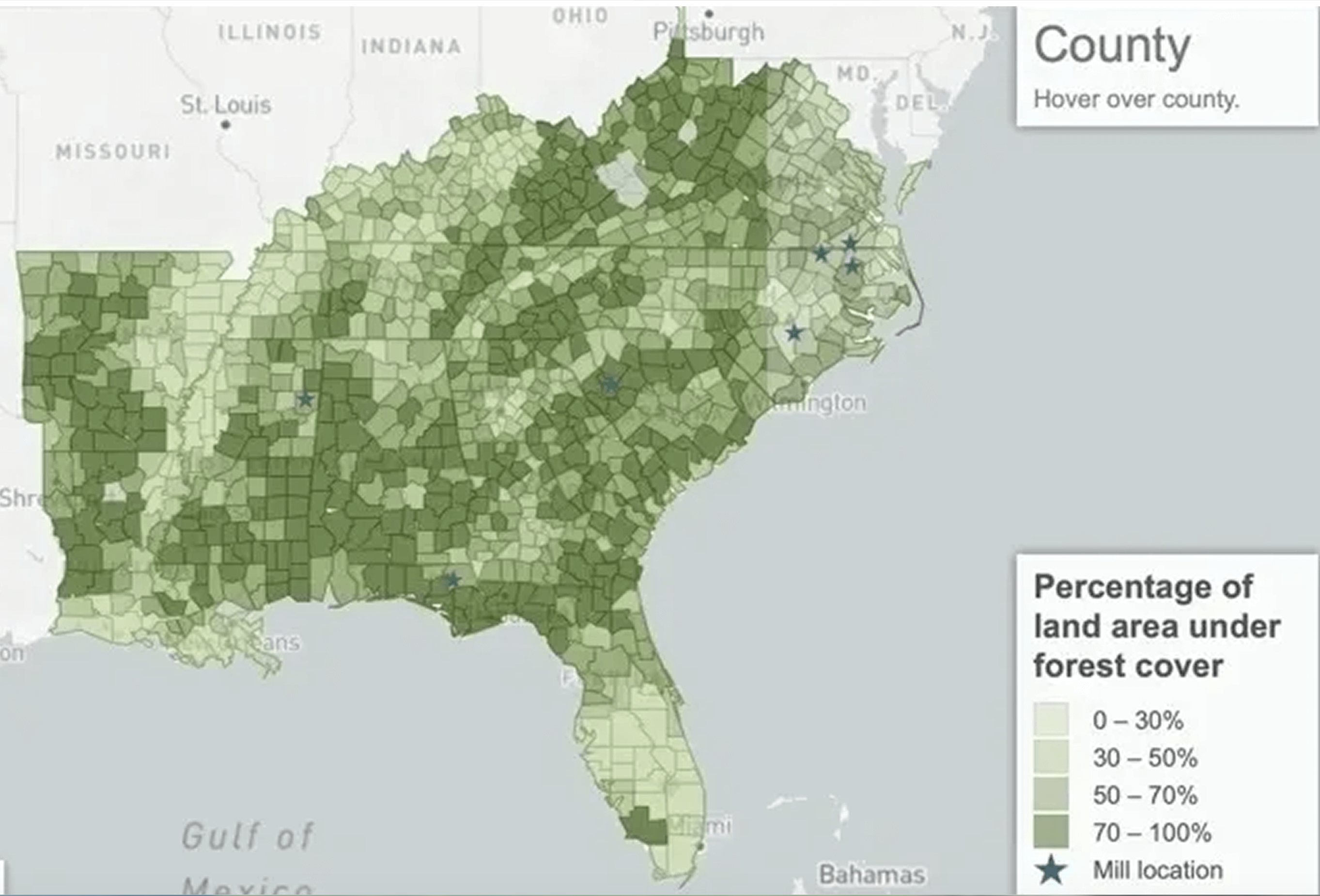
But there's something remarkable about this debate that often gets overlooked. We can actually put its central claims to the test. The wood pellet industry has been operating in the U.S. Southeast for nearl two decades. Throughout that period, scientists have been systematically measuring the region's forests.
So rather than relying exclusively on assumptions about the climate impacts of biomass or projections of what might happen to forests, we can ask a more revealing question: What actually happened?
From assumptions to evidence
For decades, the U.S. Forest Service has maintained one of the world's most sophisticated forest monitoring systems. Its Forest Inventory and Analysis program includes roughly 326,000 permanent sampling locations nationwide, enabling scientists to track forest growth, harvesting, mortality, and carbon storage over time.
Researchers have used this extraordinary resource to examine whether the expansion of wood pellet production has depleted carbon stocks in Southern forests. A landmark 2022 study published in Scientific Reports analyzed observations from more than 19,000 forest inventory plots between 2000 and 2019. Its conclusion was striking:
“Our estimates offer robust evidence that the wood pellet industry has met the overall condition of forest carbon neutrality.”
And this wasn't an isolated finding.
A 2017 study published in Forest Ecology and Management documented stable or increasing forest area, timber volume, and carbon stocks in two major southeastern pellet sourcing regions.
Another 2020 paper published in Scientific Reports found that pellet production was consistent with European sustainability requirements for preserving forest carbon stocks in sourcing areas, while emphasizing the importance of continued monitoring.
Three peer-reviewed studies examining historical forest conditions point toward a consequential conclusion: The expansion of wood pellet production has not been shown to cause an overall depletion of forest carbon stocks in the Southern sourcing regions studied.
Why forest carbon balance matters
Burning wood releases carbon dioxide. So how can biomass help fight climate change?
The answer lies in a fundamental difference between biomass and fossil fuels. Burning fossil fuels introduces carbon stored underground for millions of years into the atmosphere. Trees, by contrast, absorb atmospheric carbon dioxide as they grow, replenishing the carbon released when wood is burned.
The key is maintaining that carbon balance.
If forest growth and other carbon gains offset losses associated with harvesting and other processes, overall forest carbon stocks remain stable. Maintaining those stocks is a fundamental condition of forest carbon neutrality, consistent with the IPCC's framework for accounting for biogenic carbon emissions and removals.
The empirical research provides strong evidence that this condition has been met in the Southern sourcing landscapes studied.
But would forests have stored more carbon without wood pellets?
There's another argument critics make: Even if forest carbon stocks haven't declined, wouldn't Southern forests have stored more carbon without the additional demand for wood pellets?
It's a reasonable question. And the 2022 study offers an unusually useful way to investigate it.
Researchers didn't simply measure carbon stocks in forests supplying pellet mills. They compared changes in those forests with changes in otherwise similar forests outside pellet procurement areas, using statistical methods designed to isolate the industry's effects.
The researchers found no overall reduction in forest carbon stocks attributable to pellet procurement relative to comparable forests. In principal commercial procurement areas, some estimates actually showed higher carbon stocks associated with pellet industry activity.
The findings challenge the assumption that demand for wood pellets necessarily comes at the expense of forest carbon storage.
The implications extend beyond wood pellets
This research also needs to be understood in the context of Southern forestry.
The wood pellet industry emerged within a much larger forest-products economy that has supplied lumber, paper, packaging, and other essential materials for generations. Wood pellets represent an additional market for fiber within that established system—not its organizing purpose.
Maintaining forest carbon stocks is not the entirety of the climate equation. Supply-chain emissions, alternative uses of wood, and the energy being displaced also matter. But the available historical evidence offers strong support that a fundamental sustainability condition has been met.
And that matters for what comes next.
As the world seeks alternatives to fossil carbon, responsibly sourced woody biomass could help supply renewable energy, sustainable fuels, and industrial materials. Combined with carbon capture and permanent storage, it could also contribute to the carbon removals needed to achieve net zero.
The U.S. Southeast already possesses the productive forests, infrastructure, and management expertise to help meet that demand. The scientific evidence provides a compelling foundation for doing so.
Be Part of the Platform Shaping the Future of Renewable Carbon


